
Naming and Burying Your Baby
Pre-born children of all ages and stages are beloved sons and daughters of God. As such, they are worthy of dignity and care after they die at any gestational age. It is always your right to receive your baby’s remains and to lay them to rest through burial or cremation.
Naming your Baby:
“I have called you by name; you are mine.” Isaiah 43:1
Your baby was given an immortal soul by God at the moment of his or her conception. The length of your baby’s days does not change his or her eternal value in the eyes of God. Your baby’s mission was fulfilled, however much you may have wished for their life to be much, much longer.
We encourage you to name your baby. This helps you to acknowledge his or her unique identity, as well as giving your grief a more specific place to go. You can pray for your child’s soul by name and ask him or her to pray for you. If you don’t know your baby’s gender, try picking a gender-neutral name or a name related to the Feast day on or around your baby’s death. Some families pick a first and middle name that apply to each gender. Whatever you choose, your baby loves you and will not mind being called by a name that does not match his or her gender. You are their momma and your hearts will always be connected.
We pray you have peace about your child being with God even though your baby died without baptism. You can read more about that here or listen to our conversation with Fr. Rusty Bruce on our podcast, It’s Not for Nothing.
Funerals, Memorials & Blessings:
If you were unable to have a funeral or burial because your child’s remains were not available, please know that this was not a failure of your love. The absence of remains does not diminish your child’s dignity, the reality of his or her life, or the bond you continue to carry. Your child is a unique and unrepeatable person, known and loved by God. The Church can still accompany you through a Memorial Mass or another time of prayer in which your child is remembered and entrusted to God’s mercy. You may also ask a priest or deacon to offer an appropriate blessing for you and to pray with you over any meaningful keepsakes from your child’s life.
After the death of your child, you may ask your parish about Catholic funeral rites, a memorial Mass or prayer service, and burial. These sacred rites honor your child’s life, entrust your child to God, and allow the Church to accompany your family in grief.
Catholic funeral rites are available for baptized children. When a child dies before Baptism, and the parents intended to have the child baptized, the local bishop may permit an ecclesiastical funeral. Your priest or parish can help you request this permission when necessary. (see Canon 1183.2)
The Church provides funeral prayers appropriate for children, including children who died before Baptism when the funeral has been permitted. Your priest will help select the rites and prayers appropriate to your child’s age, baptismal status, and the circumstances of the death.
Eternally Loved from Red Bird Ministries is a resource that may help you prepare for your child’s funeral and burial.
The prayers and rituals of the Church provide a sacred way to remember your child, express your grief, and entrust your child to the mercy of God.
If a funeral was not celebrated at the time of your child’s death—or if you desire another occasion of prayer later—you may ask your parish about a memorial Mass, a prayer service, or a Mass intention. This can be arranged even many years after the death.
A priest or deacon may offer the Church’s Blessing of Parents After a Miscarriage or Stillbirth, available through the USCCB
You may also bring meaningful keepsakes—such as photographs, footprints, or a blanket—to your priest or deacon and ask him to pray with your family or determine whether an appropriate blessing may be offered.
You may request that a Mass be offered for your child on the anniversary of the death, the child’s birthday, or another meaningful date. This can become a continuing way to remember your child within the prayer of the Church and entrust your child to God.
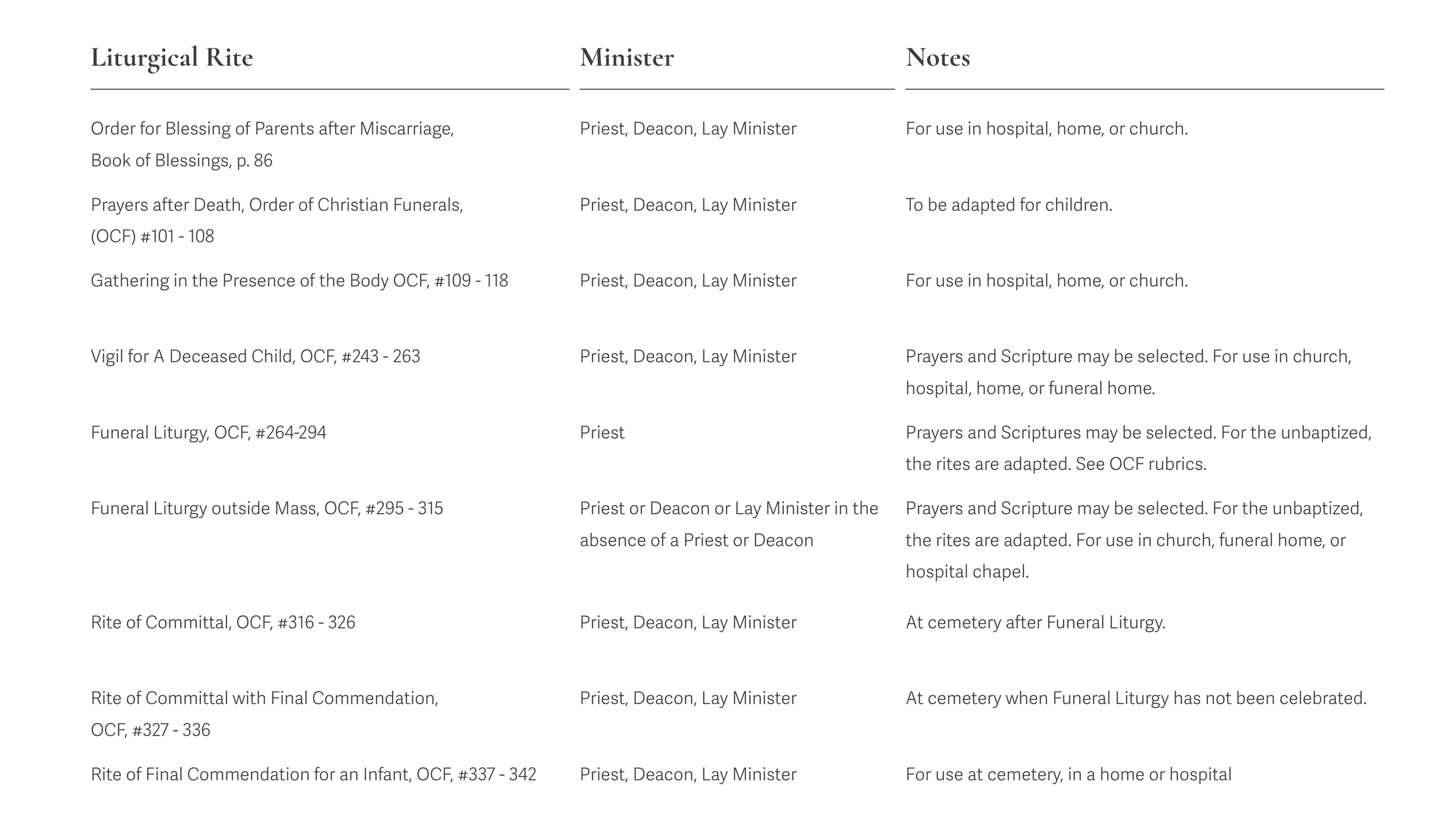
A Quick Reference Guide to Liturgical Rites for Deceased Infants and Their Families
How to Bury your Baby:
Laws vary by state on when a funeral home must be used for a burial. Most likely, if your baby died past 20 weeks gestation, you will need to contact a funeral home to manage your child’s burial.
Funeral homes usually offer a selection of infant caskets, but even these may be too large for a baby who died earlier in the womb. See our page here on caskets for pregnancy and infant loss. It may be possible to purchase or handcraft a special casket for your baby, but keep in mind that cemeteries may have certain regulations on what materials are allowed. Hobby and craft stores sell small unfinished wooden boxes that would be appropriate if allowed.
Your baby’s body can be wrapped in a special blanket or burial gown. A hospital ministry may provide crocheted items free of charge. Rest in His Arms is a ministry which provides free burial wraps made from repurposed wedding gowns that are then blessed by a priest.
Where to Bury your Baby:
A Catholic cemetery is the recommended burial place for your baby’s body as it will ensure respect for his or her grave in sacred ground.
Many cemeteries have space set aside for babies which are often free of charge. You may be able to obtain permission to bury your baby at another family member’s grave. Your priest or funeral home director should have information for your area. Purchasing a full plot is rarely necessary.
There are many lay apostolates which aim to support families of pregnancy and infant loss through burial services. Here are a few, but we encourage you to look for one in your area as well.
Covenant Resources offers a list of cemeteries for miscarriage in AZ, CO, IN, KY, NV, and OH
A Mom’s Peace in the Norther Virginia/Maryland area
Morgan’s Place Cemetery in Sidney, Ohio